
WHAT IS POLYGRAPHY?
An Introductory Lesson in Forensic Psychophysiology
ForenSEEKs | Seeking Truth Through Forensics
Have you ever wondered how investigators assess a person's physiological responses during a forensic examination?
Welcome to Polygraphy 101, your introductory guide to the science, technology, and professional practice of polygraph examinations!
WHAT IS POLYGRAPHY?
Polygraphy is the professional practice of conducting polygraph examinations, which involve recording and analyzing selected physiological responses while an individual answers a structured series of questions.
A polygraph, commonly known as a lie detector, is an instrument designed to simultaneously record several physiological activities, including:
🫀 1. Cardiovascular Activity
Measures changes in blood pressure and pulse or heart rate.
🫁 2. Respiratory Activity
Records breathing patterns, including changes in respiration rate and amplitude.
💧 3. Electrodermal Activity (EDA)
Measures changes in the electrical conductance of the skin associated with sweat gland activity, which may vary with physiological arousal.
Depending on the instrument and examination protocol, additional physiological parameters may also be recorded.
HOW DOES A POLYGRAPH EXAMINATION WORK?
A professional polygraph examination generally involves several stages:
1. Pre-Test Interview
The examiner explains the procedure, discusses relevant information, and reviews the questions to be used during the examination.
2. Instrumentation and Data Collection
Appropriate sensors are attached to the examinee to record selected physiological responses while the examination questions are presented.
3. Physiological Data Analysis
The examiner evaluates the recorded physiological patterns using established examination procedures and appropriate analytical methods.
4. Professional Assessment and Reporting
The examiner documents the findings and communicates the results within the limitations of the examination.
DOES A POLYGRAPH DETECT LIES DIRECTLY?
No. A polygraph does not directly detect deception, nor does it identify a lie simply by measuring physiological activity.
Instead, it records physiological responses that may be associated with psychological or emotional processes, including arousal, stress, and other factors.
These responses are not unique to deception. Fear, anxiety, medical conditions, medications, and other variables may influence physiological measurements.
Consequently, polygraph results must be interpreted cautiously by appropriately trained examiners using validated methods and suitable examination protocols.
A polygraph examination is not a substitute for corroborating evidence, a thorough investigation, or sound professional judgment.
WHY IS POLYGRAPHY IMPORTANT IN CRIMINAL JUSTICE?
When appropriately used, polygraphy may serve as an investigative aid in certain contexts, including:
🔹 Criminal investigations and investigative interviews
🔹 Personnel screening and security-related assessments
🔹 Specific-issue examinations in authorized investigative settings
🔹 Research and professional training in forensic psychophysiology
Its application must consider scientific limitations, ethical standards, applicable laws, and the policies governing the particular investigative setting.
Remember: Scientific instruments provide data. Professional examiners must interpret that data responsibly.
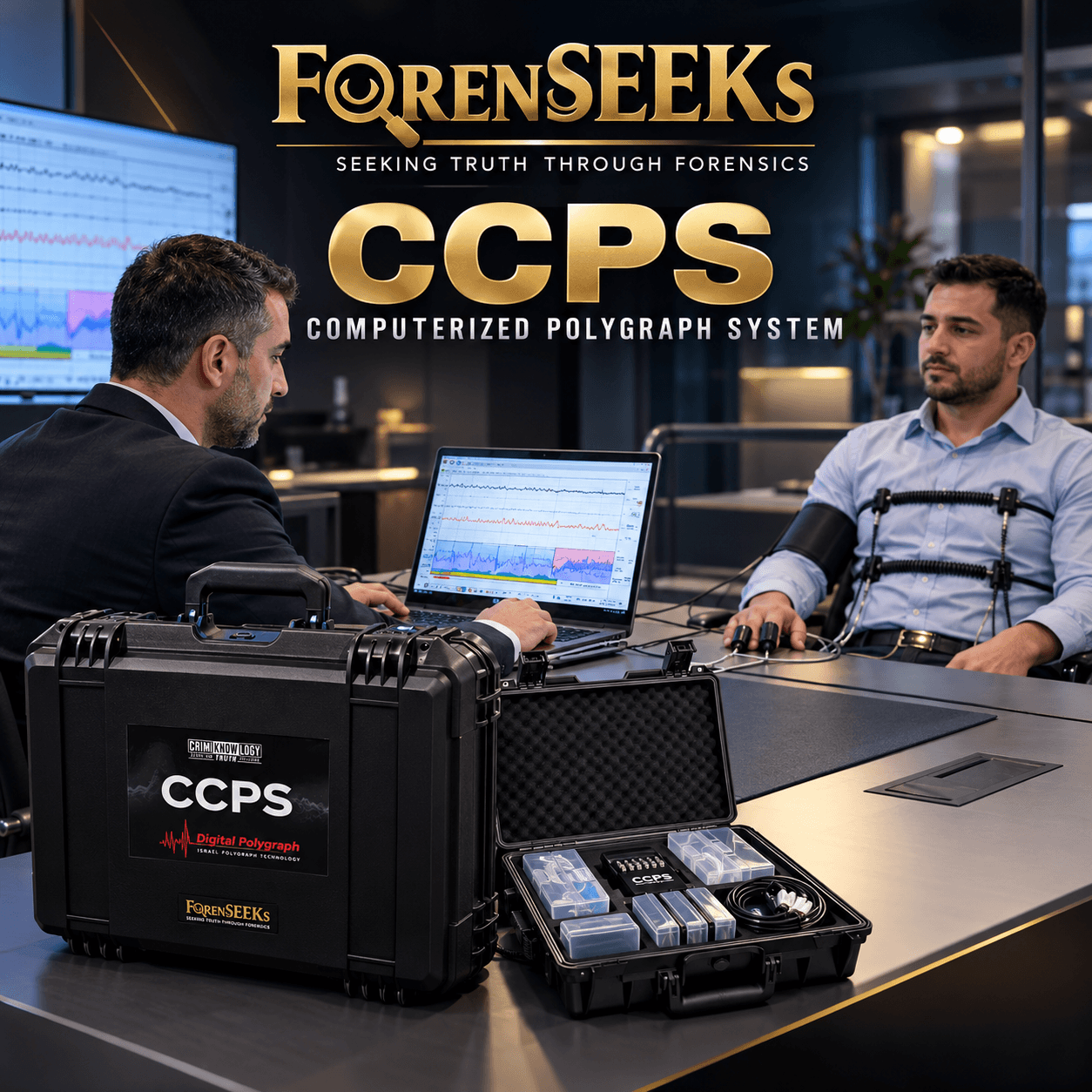
INTRODUCING THE CrimiKNOWlogy COMPUTERIZED POLYGRAPH SYSTEM (CCPS)
At ForenSEEKs, we believe that forensic education and investigative technology should work together to advance professional competency.
We are introducing the CrimiKNOWlogy Computerized Polygraph System (CCPS)—a computerized polygraph system presented under the ForenSEEKs brand.
Designed for polygraph-related applications, CCPS represents our commitment to providing technology-oriented solutions for the criminal justice, industrial security, and forensic science communities.
🔬 CCPS | Computerized Polygraph System
🏷️ Brand: ForenSEEKs | ForenSEEKs International
Our mission is to support forensic professionals, criminology educators, and relevant institutions through the continuing development and provision of forensic science equipment and educational resources.
As with any polygraph instrument, its capabilities, compatibility, analytical methods, and performance must be evaluated against documented technical specifications and appropriate scientific validation.
ForenSEEKs — Seeking Truth Through Forensics.
📣 FOLLOW OUR PAGE!
Stay connected with ForenSEEKs for more introductory lessons, forensic science insights, equipment features, and educational content for criminologists, investigators, educators, and forensic science enthusiasts.
💬 DISCUSSION QUESTION:
If a polygraph records physiological responses rather than deception itself, what factors should an examiner consider before interpreting the results?
Share your thoughts in the comments!
#ForenSEEKs
#Polygraphy #PolygraphExamination #ForensicPsychophysiology #Criminology #ForensicScience #CriminalInvestigation #CCPS #ComputerizedPolygraphSystem