
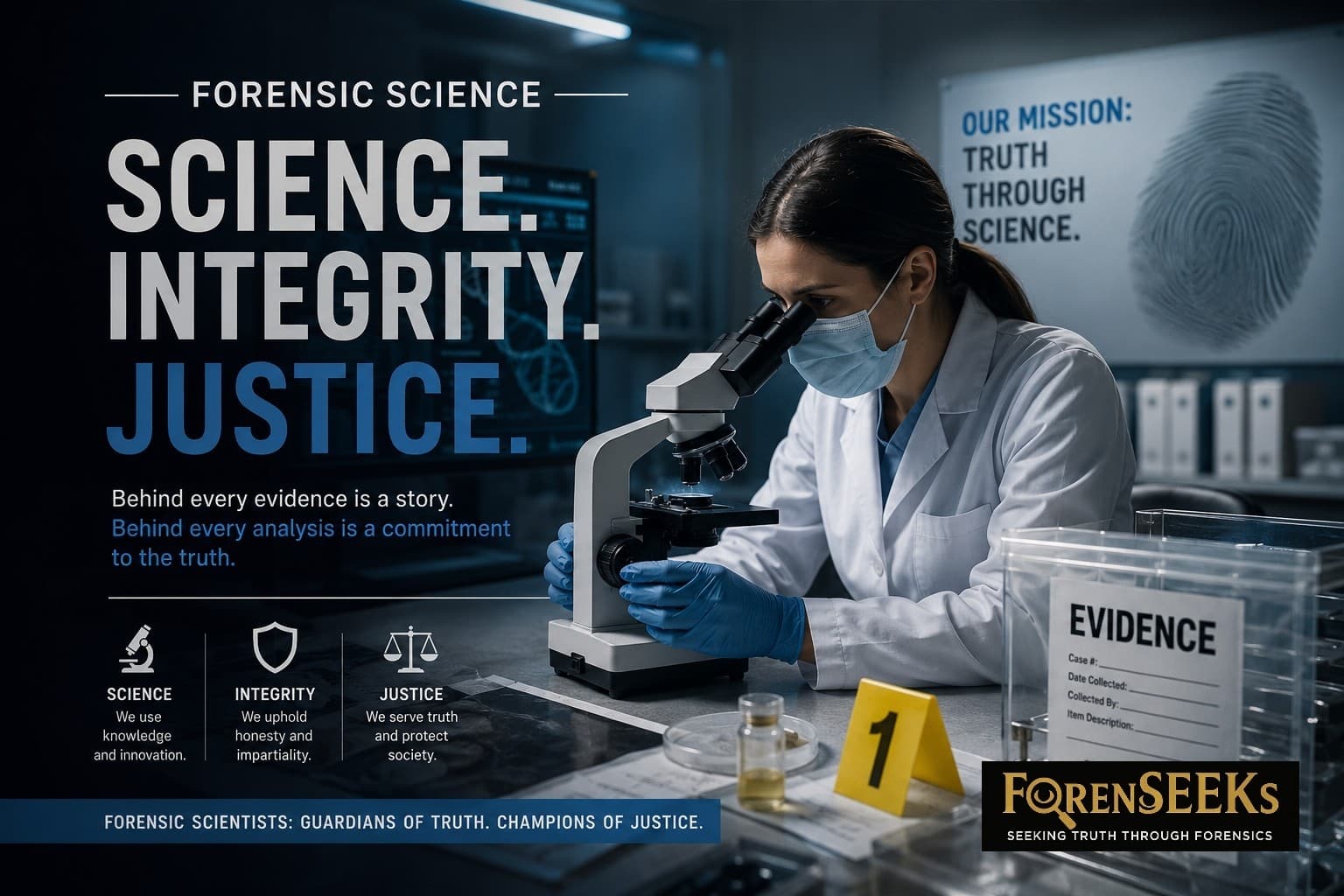
The Essential Qualities of a Forensic Scientist
A Professional Manifesto for the Global Forensic Science Community
Forensic science is not merely a profession—it is a sacred stewardship of truth. Every forensic scientist serves at the intersection of science and justice, where lives, liberty, and public trust may depend upon the accuracy and integrity of scientific work.
The following qualities should characterize every forensic scientist.
1. Integrity
Integrity is the foundation of forensic science. A forensic scientist must remain honest in every examination, report, and testimony. Evidence must never be altered, exaggerated, hidden, or manipulated.
Motto: Truth before triumph.
2. Objectivity
A forensic scientist must never become an advocate for either the prosecution or the defense. The scientist serves only the evidence and the truth.
Motto: Follow the evidence wherever it leads.
3. Scientific Competence
Professional excellence requires continual learning. Competent forensic scientists maintain current knowledge of scientific advances, validated methods, quality assurance, and laboratory standards.
Motto: Excellence is a lifelong pursuit.
4. Critical Thinking
Every conclusion should be based on careful observation, sound reasoning, and scientifically supported interpretation. Assumptions and bias have no place in forensic science.
Motto: Think before concluding.
5. Attention to Detail
Small details often determine the outcome of an investigation. Precision in collection, documentation, preservation, analysis, and reporting is essential.
Motto: Every detail matters.
6. Impartiality
Justice demands neutrality. Personal opinions, political beliefs, financial interests, or emotional influences must never affect scientific conclusions.
Motto: Neutrality protects justice.
7. Accountability
Every forensic scientist must be willing to explain, defend, and document every scientific procedure and conclusion.
Motto: Own every conclusion.
8. Ethical Courage
There may be times when scientific truth conflicts with expectations or external pressure. A forensic scientist must have the courage to report the truth regardless of personal consequences.
Motto: Truth requires courage.
9. Professional Humility
Science continues to evolve. Competent forensic scientists acknowledge limitations, recognize uncertainty when appropriate, and remain open to peer review and new evidence.
Motto: Confidence without arrogance.
10. Respect for Human Dignity
Behind every case is a human story. Victims deserve dignity, suspects deserve fairness, families deserve compassion, and society deserves justice.
Motto: Serve people through science.
11. Effective Communication
Scientific findings must be communicated clearly, accurately, and honestly in reports, testimony, and professional discussions.
Motto: Explain science with clarity.
12. Commitment to Justice
The ultimate mission of forensic science is not to secure convictions or acquittals but to assist the justice system by revealing reliable scientific truth.
Motto: Science in the service of justice.
The Forensic Scientist's Professional Creed
«"I will pursue truth without prejudice, examine evidence without bias, report findings without fear, and testify with honesty. I will uphold scientific excellence, protect the integrity of evidence, respect every human life affected by my work, and remain accountable to the highest standards of ethics and professionalism. My loyalty belongs neither to the prosecution nor the defense, but to scientific truth and the cause of justice."»
Final Charge
A forensic scientist is more than an examiner of evidence. He or she is a guardian of truth, a servant of justice, and a steward of scientific integrity. The credibility of forensic science depends not only on advanced technology but also on the character of those entrusted to practice it.
"When science is guided by integrity, justice is strengthened."